

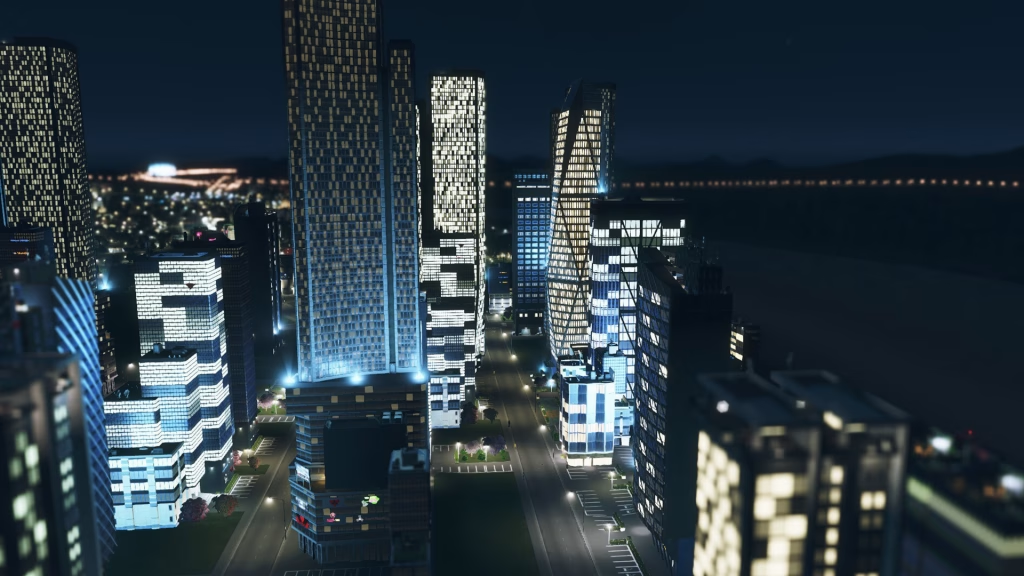
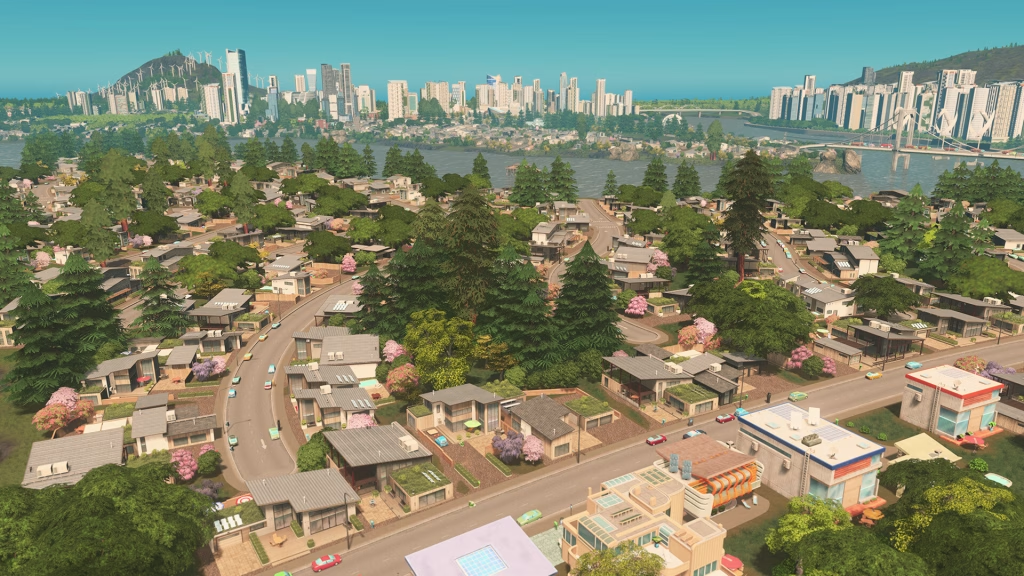
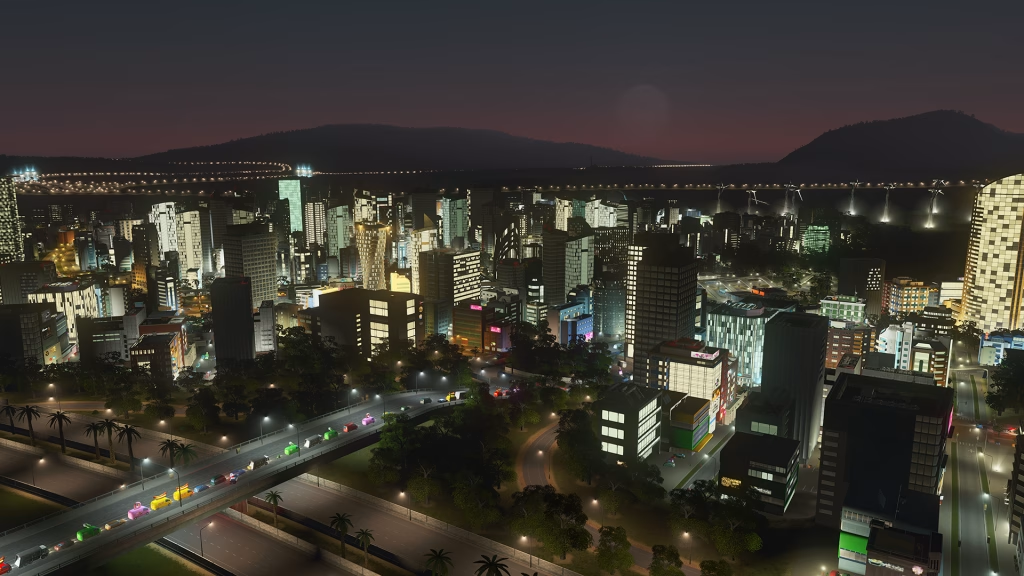
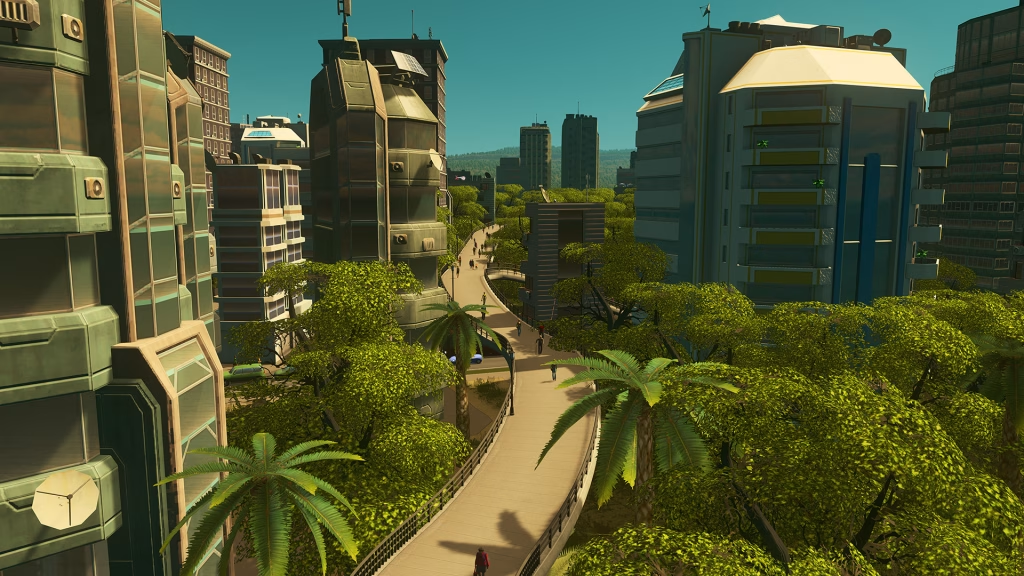
Cities: Skylines is a 2015 city-building game developed by Colossal Order and published by Paradox Interactive. The game is a single-player open-ended city-building simulation. Players engage in urban planning by controlling zoning, road placement, taxation, public services, and public transportation of an area. They also work to manage various elements of the city, including its budget, health, employment, traffic, and pollution levels. It is also possible to maintain a city in a sandbox mode, which provides more creative freedom for the player.
Cities: Skylines is a progression of development from Colossal Order’s previous Cities in Motion titles, which focused on designing effective transportation systems. While Colossal felt they had the technical expertise to expand the Cities gameplay into a more full-featured city simulation game, their publisher Paradox Interactive initially held off on the idea, fearing the market dominance of the SimCity series. However, they reconsidered after the critical failure of the 2013 SimCity game, which provided an opportunity for Paradox to establish a competing franchise. Colossal’s goal was to create a game engine capable of simulating the daily routines of nearly a million unique citizens, while presenting this to the player in a simple way, allowing the player to easily understand various problems in their city’s design. This includes realistic traffic congestion, and the effects of congestion on city services and districts. Since the game’s release, various expansions and other DLC have been released for the game. The game also has built-in support for user-generated content.
The game was first released for the Windows, macOS, and Linux operating systems on 10 March 2015. Console ports by Tantalus Media were released for the Xbox One and PlayStation 4 game consoles in 2017, for the Nintendo Switch in September 2018, and for Google Stadia in May 2022. A remastered edition, also by Tantalus, was released for the PlayStation 5 and Xbox Series X/S in February 2023. An expanded edition is set to release for Nintendo Switch 2 in October 2026. The game received favourable reviews from critics, and was a commercial success, with more than twelve million copies sold on all platforms as of June 2022.
A sequel, Cities: Skylines II, was released on 24 October 2023 to mixed reviews.

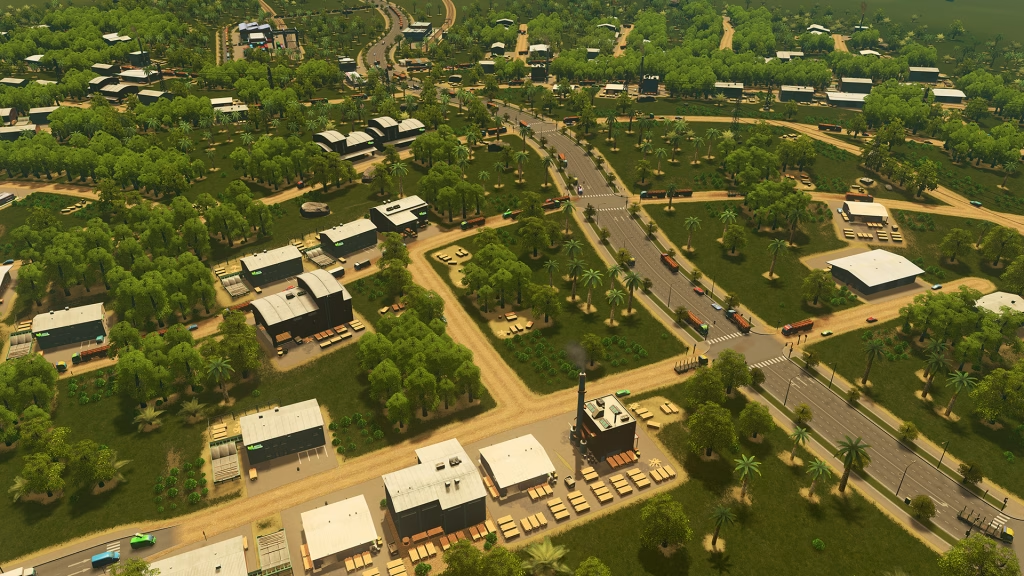
The player starts with a plot of land – equivalent to a 2-by-2-kilometre (1.2 mi × 1.2 mi) area – along with an interchange exit from a nearby highway, access to a body of water, as well as a starting amount of in-game money. The player proceeds to add roads and residential, industrial and commercial zones, and basic services like power, water and sewage, to encourage residents to move in and supply them with jobs.
As the city grows beyond certain population tiers, the player unlocks new city improvements, including schools, fire stations, police stations, health care facilities and waste management systems, tax and government edicts, mass transit systems, and other features for managing the city. One such feature enables the player to designate parts of their city as districts. Each district can be configured by the player to restrict the types of developments permitted or to enforce specific regulations within the district’s bounds, such as only allowing for industrial sectors devoted to agriculture, offering free public transportation for the district to reduce traffic, raising or reducing taxes for the various classes of development, or, with the Green Cities DLC, discouraging fossil-fuel vehicles from entering a district while not discouraging electric vehicles, reducing noise pollution caused by traffic.
Buildings in the city have various development levels that are met by improving the local area, with higher levels providing more benefits to the city. For example, a commercial store will increase in level if nearby residents are more educated, which in turn will allow it to hire more employees and increase tax revenue for the city. When the player has accumulated enough residents and money, they can purchase neighbouring plots of land, each equivalent in size to the starting land area, allowing them to build up eight additional parcels out of 25 within a 10-by-10-kilometre (6.2 mi × 6.2 mi) area. The parcel limitation is to allow the game to run across the widest range of personal computers, but players can use Steam Workshop modifications to open not only all of the game’s standard 25-tile building area, but the entire map (81 tiles, 324 square kilometres or 125 square miles).
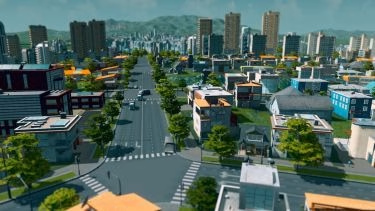
The game also features a robust transportation system based on Colossal Order’s previous Cities in Motion, allowing the player to plan out effective public transportation for the city in order to reduce traffic congestion and generate transit revenue. Roads can be built straight or free-form, and the grid used for zoning adapts to the shape of the adjacent roads; cities do not need to follow a square grid plan. Roads of varying widths (up to major freeways) accommodate different traffic volumes, and variant road types (for example, avenues lined with trees or highways with sound barriers) offer reduced noise pollution or increased property values in the surrounding area at an increased cost to the player. The road system can be augmented with various forms of public transportation such as buses, taxis, trams, trains, ferries, and metro systems.
Modding, via the addition of user-generated content such as buildings or vehicles, is supported in Cities: Skylines through the Steam Workshop. The creation of an active content-generating community was stated as an explicit design goal. The game includes several pre-made terrains to build on, and also includes a map editor to allow users to create their own maps, including the use of real-world geographic features. Mods are also available to affect core gameplay elements; pre-packaged mods include the ability to bypass the aforementioned population tier unlock system (Unlock All), unlimited funds, and a higher difficulty setting.





Reference:


Recent Comments