


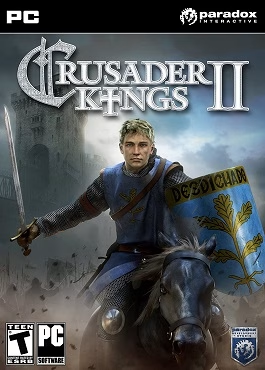
Crusader Kings II is a grand strategy game developed by Paradox Development Studio and published by Paradox Interactive. Set in the Middle Ages, the game was released on February 14, 2012, as a sequel to 2004’s Crusader Kings. On October 18, 2019, the video game became free to play. A sequel, Crusader Kings III, was released on September 1, 2020. Crusader Kings II attracted a wider audience than Paradox’s previous games, contributing to the growth of the company.
The game is a dynasty simulator in which the player controls a medieval dynasty from 1066 to 1453. Players are able to start at any date between September 15, 1066, to December 31, 1337. Through the strategic use of war, marriages and assassinations, among many other things, the players work to achieve success for their dynasty.
The game depicts or mentions numerous historical figures, including William the Conqueror, Charlemagne, Genghis Khan, Harold Godwinson, Robert Guiscard, Robert the Bruce, Harald Hardrada, El Cid, Constantine X Doukas, Harun al-Rashid, Alexios I Komnenos, Richard the Lionheart, Ivar the Boneless, Alfred the Great, Baldwin I of Jerusalem, Boleslaw the Bold and Saladin, but allows for the player to choose less-significant figures such as minor dukes and counts, and for the creation of entirely new characters with the use of the Ruler Designer DLC.
Success is defined solely by the player. The only in-game objective is to obtain as many prestige and piety points as possible in order to surpass the various historically relevant European dynasties in a fictional prestige ranking system (the three most prestigious ones being the Capetian, the Rurikid and the Habsburg dynasties). The game ends when the player’s current character dies without an heir of the same dynasty to succeed him/her, when all landed titles of the count rank or above are stripped from all members of the player’s dynasty (including themselves), or when the game reaches its end in 1453 (unless the player is in “observer mode”, at which point the game will continue onwards).
The game employs a genetics and education system, through which children inherit many traits, culture, religion and skills from their parents and guardians. This adds an additional layer of strategy to marriages, such that a player will attempt not only to form beneficial alliances, but also to select marriage partners with strong heritable traits to maximise the quality of offspring and thus strengthen the dynasty. This requires balancing sometimes conflicting interests; for example, while one possible marriage might allow some desirable alliance to be formed with another ruler, it may also require marrying a spouse with some undesirable traits. Such a trade-off can occur in the reverse as well: one possible spouse could possess highly desirable traits but yield no new alliances for the player’s dynasty.
While the player can choose to play as any noble with at least a county in their possession, there are some government types that are unplayable without modding the game. These include theocracies (such as The Papacy), holy orders, mercenaries, and republics. The merchant republic government type, however, is playable with The Republic expansion. In addition, all non-Christian characters are unplayable without the purchase of the DLC that unlocks them, including Muslims, Jews, Hindus, Buddhists, Taoists, Zoroastrians, Jains, Zunists and various pagans.


Reference:









Recent Comments