

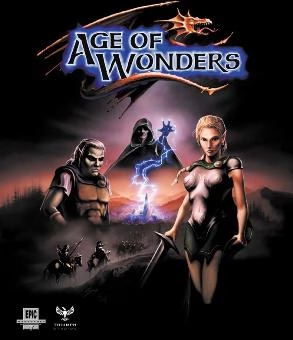
Age of Wonders is a 1999 turn-based strategy game co-developed by Triumph Studios and Epic MegaGames, and published by Gathering of Developers.
Age of Wonders underwent a long production cycle, and was originally developed under the name World of Wonders. In 1997, the team scrapped its existing work and restarted development, which resulted in Age of Wonders.
The game won positive reviews and was a moderate commercial success, with global sales of roughly 200,000 units by 2001. It began a franchise and was followed by five sequels: Age of Wonders II: The Wizard’s Throne, Age of Wonders: Shadow Magic, Age of Wonders III, Age of Wonders: Planetfall, and Age of Wonders 4. In 2010, the first game was re-released on GOG.com and Steam.
Age of Wonders is a turn-based strategy game that takes place from an isometric perspective, which consists of hexagonal tiles. Units are arranged into groups (also known as parties or stacks) of up to eight units; a single such group occupies one tile. Cities occupy between one and four tiles, and other structures generally occupy a single tile. Units within the game have a limited number of movement points, which are replenished at the beginning of each turn. Two turn systems are used – sequential (or “classic”), where players take their turns in order, or simultaneous, where all players can move units at once. In practice, actions in the latter system are added and executed via a queue.
The game has a single-player campaign, playable from two sides (more campaigns have been made by the community since release), and many maps, both included and user-created that can be played in Hotseat mode, over a LAN, on the Internet, or by email (PBEM). Up to 12 players can participate in a single game, depending on the map. Simultaneous turns are only available in single player and live multiplayer games; PBEM and hotseat games, and all combat, use the sequential turn system.
Each player leads a certain race. There are 12 races available in the game, though not all of them may be present on every map, and of those which are, not all may be playable. List of races includes traditional fantasy Elves, Lizardmen, Humans, Goblins, Dark Elves, Undead, Orcs, Dwarves and Halflings, as well as several unique ones such as Frostlings, Azracs, and Highmen. Races, as well as units not belonging to any specific race, such as dragons and giants, have a certain alignment, which can be good, neutral, or evil. According to their alignment and certain other factors, cities and independent units of one race can be friendly or hostile towards another race. This can manifest itself in different ways; for example, an orc city is not likely to surrender to the elves, and if conquered, may revolt unless there is a strong military presence in it to oppress the population. Units of hostile races forced to fight alongside each other in a single group will have lower morale, and are more likely to desert. Race relations can be improved by acts of goodwill towards other races, such as upgrading their cities, or hampered by razing, looting, or migrating cities belonging to that race. Diplomacy can also affect this and even an alliance with one race might affect the relation of another race. There are also several spells which have a global effect on race relations.
There are two resources, gold and mana. Gold is used to build units, buy heroes, cities and spells (in Wizard Towers), upgrade cities. Mana is used to cast and research spells and use altars. Units can be built in cities, which can be further upgraded to produce more advanced units. Also, wandering independent (not belonging to any player) groups of units can be hired, if they are well-disposed towards the player. Units may have different strength, reflected by their level, which can vary from 1 to 4. Units under player control require a certain amount of gold every turn as an upkeep, the size of which depends upon the level of the unit. Summoned units use mana for upkeep instead of gold. Units earn experience for killing other units. The amount of experience earned depends on the number of enemy units killed as well as their level – the level of the enemy killed is the amount of experience gained. Upon earning a certain amount of experience, the unit gets a silver medal, and later on a gold one. Higher level units require more experience to earn medals. Units with medals also get slight increases to their basic parameters, or otherwise improve their combat performance.
A special type of unit, a hero, can only be hired when they appear at random at one of the player’s cities. Heroes earn experience points just like all other units do; however, instead of getting medals for it, they gain levels to a maximum of level 30. Upon reaching the next level, they get a number of skill points, which a player can then spend to improve their parameters and teach them special abilities. This point system is similar to that used in many role-playing video games. In addition to that, heroes are the only units in the game which can learn the Spell Casting special ability, allowing them to cast spells. The Spell-Casting special ability can be upgraded from level I to level V. Each level provides more mana income/research points and also improves the channeling points allowing the hero to cast more/better spells each turn. Some spells require many turns to cast even with level V Spell-Casting. Heroes can not work together to cast one spell – each must cast it individually. Unlike common units, heroes can be brought from dead by magical means, although such experience will greatly decrease their morale.
Scattered across the board are a series of structures known as altars. These altars harness different types of magic and can be used as large-scale weapons. To fire off an altar, a player must first take control of it, then target a spot on the board (within a certain range), then click to cast the spell over the targeted area. Altars require 500 mana to fire. Each turn, they accumulate 50 mana charge, requiring 10 turns to fully recharge. Players with enough mana crystals may fire an altar multiple times sequentially without recharging.
Spells are divided into three types – unit spells which enhance a single unit, combat spells which are used to directly damage or handicap the enemy during combat, and global spells which can affect terrain, structures and groups of units on the global map, or summon magical creatures to player’s aid. All have different mana costs depending on how advanced they are, and some of the more powerful unit and global spells can take more than one turn to cast. Counterspells to block and dispel unit and global enchantments are also available. Each spell furthermore belongs to one of the eight spheres of magic: Life, Death, Air, Earth, Fire, Water, Cosmos and Secret/Chaos. Mana, the magical energy required to research and cast spells, is channeled from magic nodes. Some of those are generic, and provide equal (though small) amount to caster of any sphere. Others are linked to one of the elemental planes, and only channel a specific kind of energy; thus, a Fire node, for example, can only be used by a player who chose the Fire sphere. Heroes with Spell-Casting also generate mana, your King/Leader more so than others.


Reference:







Recent Comments